How To Develop And Track A Marketing Budget
- Budgeting is an important part of your marketing plan. You need to allocate resources for different marketing strategies.
- To prepare a marketing budget, determine your goals and the optimal ways to reach your target audience.
- Small business marketing costs vary widely, from a few thousand dollars a year to thousands of dollars a month.
- This article is for entrepreneurs and small business owners who want to set a marketing budget that delivers results without negatively impacting profits.
Every business marketing plan should include a marketing budget, a specific amount of money the business will allocate to promoting its products and services. Determining your marketing budget can be difficult, especially if you're new to marketing. Marketing costs can vary greatly depending on a company's industry, location, and purpose.
A marketing budget determines the exact amount allocated to employee wages, office space, equipment, marketing communications, advertising design, and specific marketing channels. Your budget helps you align your marketing strategy with your business goals and allocate money for marketing campaigns with the best return on investment (ROI).
We'll learn the steps to creating a marketing budget, what your marketing costs are, and how to track your marketing budget and measure its success.
 You know ? Advertising, marketing, and public relations are all methods of promoting your business and generating leads. Marketing raises awareness, advertising uses paid platforms, and public relations strengthen brand relationships.
How to develop a marketing budget
Companies usually set quarterly or annual marketing budgets. It should be comprehensive and cover all the projects your team plans to develop in the short and long term.
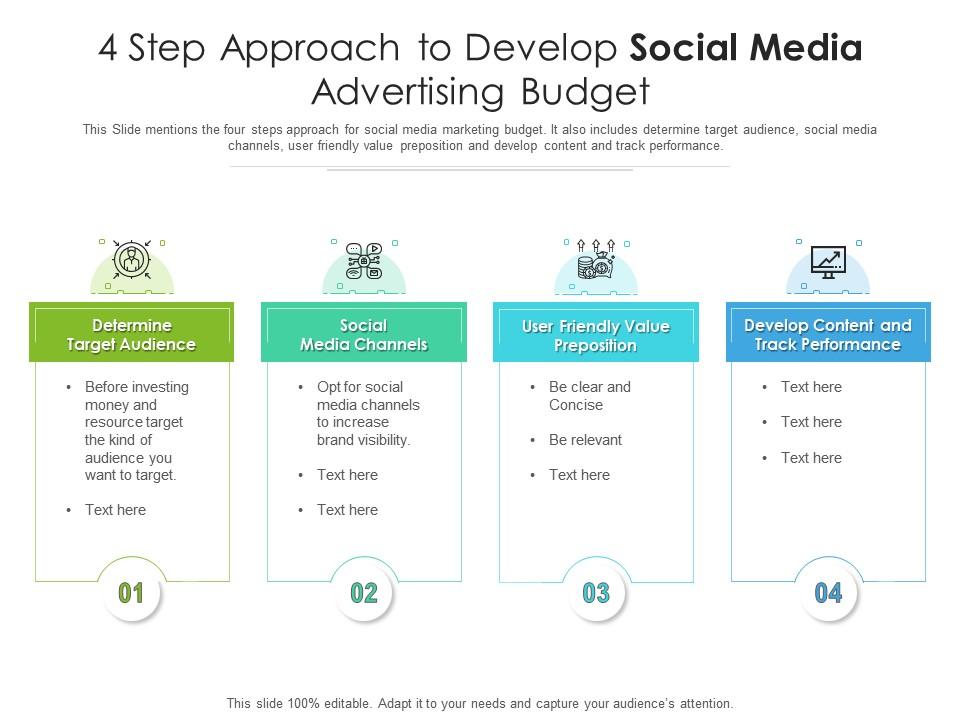
Follow these four steps when setting your marketing budget.
1. Define your marketing goals.
Marketing aims to create a sales funnel or direct sales to increase overall revenue. To create an effective marketing budget, you need to define short- and long-term marketing goals and set Key Performance Indicators (KPIs) as part of your overall marketing strategy.
Some examples of short-term goals are:
- The website bounce rate is as low as 5%.
- Get 10 good comments per week on social media posts.
- Increase your brand awareness by gaining 100 new followers on social media every month.
Some examples of long-term goals are:
- Be on the first page of Google for the first three keywords.
- Build a sales funnel that consistently generates 20% of new customers over the next three years.
- Create a marketing automation workflow with email marketing that saves your team five hours a week.
 N.B. If you want to explore email marketing, check out our review of the best email marketing software to find the right solution for your business.
2. Understand your target audience (buyer personas).
Buyer personas are fictional representations of your target customers. You can have more than one buyer, but don't try to have more than five buyers; After all, not everyone can be your target audience.
When developing your buyer personas, be specific and let the data guide you. Here are some ways to collect data to help develop your buyer personas:
- Survey your existing customers.
- Interview people who you think might be your target audience.
- Use Google Analytics to determine the demographics of your audience.
- Use Facebook Insights to track how users interact with your brand.
Enter the following information for each buyer ID:
- Site:
- age
- Marital status
- Position:
- Expected acceptance
- education:
- Motives and goals
- Sources they turn to for information
- What makes their life easier?
- What keeps them up all night?
- As a bonus, submit a fake name and photo
3. Understand your market and your competition.
Market research, especially buyer demographics, can help you better understand your target market.
To understand your market, evaluate the following information:
- General demographic information. Where do your customers live? What is their education level and average income?
- Influencing External Factors: What external forces can affect them and affect sales? For example, economic trends can shape how you plan your budget, and technology trends can encourage shoppers to use different ways to shop or pay.
- customers' wants and needs. Another way to understand your market is to assess their wants and needs. What are the main needs that your company can meet in the market? Consider overall customer needs. For example, a target market's needs may include feeling more secure in their environment or saving money.
Market budgeting also includes competitive research. Consider the following questions:
- Who is qualified?
- What types of advertising and marketing strategies are they currently using?
- How much money do they spend on the marketing department?
The type of industry can affect marketing costs. According to the February 2022 CMO survey, B2B product companies typically spend an average of 9.4% of their revenue on marketing; For B2B service companies, the corresponding figure is 10%. B2C product companies spend an average of 14.2% of their revenue on marketing; The corresponding indicator for B2C services is 8.7%.
4. Choose your marketing channel.
Market where your customers go to get the best bang for your buck. The marketing channels you should consider fall into four main categories:
- Digital Marketing. Digital marketing channels include social media marketing, online content marketing, automated or manual email marketing, pay-per-click online advertising, or social media (media) advertising.
- Internal Marketing. Many inbound marketing channels overlap with digital marketing, including SEO, business blogging, YouTube and Vimeo videos, e-books, and other elements of your content strategy.
- External marketing. Outbound marketing can be difficult to track, so it pays to combine it with inbound marketing. The most traceable form of outbound marketing is email marketing. Other types of outdoor marketing include television and radio commercials, direct mail, press releases, trade shows, and promotional products.
- Brand awareness campaign. These channels may overlap with other channels and may include social media marketing and advertising, content marketing, public relations, video marketing and advertising.
You know ? Each marketing channel has an associated cost . Social media business platforms tend to be the most profitable.
How much should you budget for your marketing budget?
Companies use a variety of strategies to prepare their marketing budgets, including:
- based on income. One way to determine your marketing budget is to look at your annual income statement and allocate a percentage. Some companies may set aside 6.5% to 8.5% for marketing purposes. For new business ventures, the interest may be higher. Companies less than five years old should consider spending 10-12% on marketing.
- Learn about the contest. Based on previous research, you can also set a budget based on your competitors' spending.
- from top to bottom. A top-down budget plan means there's no hard and fast calculation of how much you need to spend each quarter or year. Instead, management sets the numbers and asks the marketing department to stay within those parameters.
- targeted. With goal-based marketing, management and marketing, first set goals and then set a budget to achieve them. For example, the goal might be to get X number of social media followers. Another goal might be to get X number of online conversions through your company website. Set a monetary value for each goal. For example, you can set a value of 50 cents per social media user. So getting 100 new subscribers would be $50.
Common Marketing Budget Mistakes
Because there are so many moving parts in determining your marketing budget, there is more room for error. Any misstep in the process can generally lead to ineffective marketing and potential financial difficulties for your business.
Some of the budget planning mistakes. Consider these when creating your budget.
- Invest less money in effective methods. Companies often fund old favorites even when new marketing channels are effective. The idea that a successful marketing tactic will always be effective is logical, but it is wrong. The consumer market changes frequently. What works one day may not work one day. Instead, constantly invest in new and old successful tactics. So you can keep up with changing market conditions through automation, personalization and other improvements.
- Incorrect information is not corrected. Launching a marketing method to your target audience in the dark can be a financial risk. You need to evaluate your customer base data to create relevant marketing campaigns, but bad data can lead to less effective marketing overall. Review your analysis and rule out discrepancies or irregularities before they affect your budget.
- Reducing the number of existing customers. When creating a marketing campaign, you may feel pressure to cast a wider and wider net to attract more consumers into the sales funnel. But adding new customers often costs more than keeping existing ones. A limited number of people will reach the bottom of the sales funnel, and they often have many reasons behind it. Focus on retaining these people for more and more consistent earnings growth.
- Use the previous year's marketing budget. Markets change from year to year as consumer priorities change, so a marketing budget that works one year is likely to be less effective the next. The budgeting process should always include a review of business goals and a new analysis of the current market. Discovering how new technologies, political climates, social movements, and other factors affect consumers can create new marketing opportunities.
How much do small businesses spend on advertising and marketing?
According to the US Small Business Administration, a typical recommendation for marketing expenses for a profitable business with annual sales of less than $5 million is about 8% of gross revenue.
However, the exact amount a small business spends on advertising and marketing varies widely. To give you a better idea of what to spend, the following business owners share their budgets and where those budgets go.
Dennis Wu, CEO and co-founder of Ringblaze
"We spend $3,000 a month on marketing. We're a startup in the SaaS, business phone app space. We sell business phone software that makes it easy for our customers to unlock new channels for their customers," said David Wu, CEO and co-founder of Ringblaze.
"In terms of the money we put into marketing, most of it goes into search engine optimization and content marketing," he said. "We know it's a long game, but the number of impressions and leads we've generated so far makes a lot of sense."
Within two months, Vu doubled their organic traffic, doubled their domain authority, generated 10-20 backlinks to their site, and increased their lead count by almost 30%.
"We may be lucky, but the results of digital marketing are amazing," Wu said. "Our initial suspicion was that the agency we hired wouldn't even be able to get off the ground, especially with such a small budget. Most companies I know spend at least five times that amount a month on marketing, so we're very happy with the results we've achieved. ."
N.B. If you are considering hiring a marketing company, check their credentials and choose one with experience in your field.
Dave Madrid, Freelance Developer
"I hope to do marketing, and I always prefer to do that whenever possible because it fits my company philosophy," said independent developer Dave Madrid. "This means that current outbound marketing costs are very low, but are increasing month-on-month. Outbound costs relate to targeted Facebook ads, Google ads, off-page SEO activities, and link building.
Madrid added that it is increasing its internal investment in blogging, building a following on social media, reaching out to local Facebook groups and startups, conducting surveys and asking questions to build connections.
"So far, I've found Facebook ads (more so than Google ads) to be an effective way to generate views, although engagement is best achieved through Facebook groups, our blog posts, and answering other people's questions." "
According to him, the budget for external marketing activities in Madrid has increased from an unrealistic amount of $1,000 to $5,000 per year. He continued to evaluate whether it is necessary to increase his budget.
Madrid concluded that 15% or more of gross revenue is a reasonable amount for a new company to spend on advertising and marketing. Existing companies can significantly reduce this. Up to 5% of gross income can work. You can always start small and work your way up.
Christine Marquet, Creative Director and Owner of Marquet Media
Kristen Marquette says her company spends about $30,000 a year on marketing campaigns, equipment and outsourcing, which equates to about $7,500 each quarter.
Behind this marketing budget are two brands: Marquet Media, a branding and design consultancy that provides branding, web design and PR services, and Fem Founder, a media company that publishes entrepreneurial content and marketing for female entrepreneurs.
Marquette also sells digital products on a website in New York, where she lives. Pinterest is one of its main marketing channels. This helped him build a mailing list for his digital products and courses.
Marquette is clear on the profit margin, as all traders should be. "For every dollar I invest in the Pins I promote [on Pinterest], I earn $1.30. I also invest in email marketing programs that cost about $600 a month. I use homepages as a landing page program to attract leads. ." About $30 a month and social media automation about $79 a month.
Like many entrepreneurs and small business owners, Markett wasn't sure of the ROI for marketing when he started out, so he was a little concerned with budgeting. He started with a $500 budget and experimented with Google and Facebook ads, but learned that those platforms weren't where his target customers spent the most time; They are very active on Pinterest.
Based on its experience, Market believes that every company should allocate at least 10% of the total revenue to marketing and advertising, but if they can invest that much, 12% is better.
You know ? More and more businesses are using Pinterest for business purposes due to its large user base , visual imagery, business activity and branding strategy capabilities:
How to track your marketing budget
Following the campaign, the need for geringers is not limited to those who follow the trail.
- Behind the campaign. Create one line for each campaign, showing the name of the campaign and the amount invested: Include the salaries of the employees involved and the total time required to complete each campaign: Note where campaign and time adjustments are needed:
- Lead Tracking: Create a single line item for a lead, specifying the date, lead source, campaign, assigned sales representative, record, status, and revenue earned:
As you adjust your marketing budget and refine your strategy, take it slow while adjusting one key variable: Something as simple as changing a photo in a Facebook ad and increasing your traffic by a few dollars a day can make a big difference:
Hushum. Track your marketing expenses in Microsoft Excel or use one of the many expense tracking apps and software applications available:
Marketing budget template
For more help, a marketing budget template can help: Here are some resources for marketing budget templates.
Get the most out of your marketing budget
Effective marketing is critical to the success of your business: This is how you attract new customers and keep existing ones more more: Of course, there are usually only so many resources you can devote to your efforts: Creating a budget can drive your spending to best performance channel and save enough money for all your other Mirrors enough
Isaiah Atkins contributed to the reporting and writing of this article: Several sources were interviewed for earlier versions of this article:


Comments
Post a Comment