You Must Unlearn What You Have Learned About B2C Content Marketing

I'm a big fan of Robert Rose, Content Marketing Institute's (CMI) Senior Strategy Consultant and Chief Troubleshooter at Content Advisory.
He is a pioneer in content marketing and a thought leader in the field.
So I was a little surprised when I read his recent article titled, "B2C marketers treat content marketing like a project. That's what [new research] charged."
I agree with his analysis of the strategic challenges facing B2C marketers as it is based on recent research from CMI and MarketingProfs.
According to the newly released “B2C Content Marketing Benchmarks, Budgets, and Trends – Insights for 2023” :
- 57% of B2C marketers say creating content that appeals to diverse audiences is their biggest challenge.
- 44% said they had developed agreement with the measure.
- And 40% say it differentiates our product/service from competitors.
But I respectfully disagree with the solution:
"Solutions to these three challenges focus on strategic content operations – developing a consistent long-term differentiation strategy, developing measurement plans that have proven themselves over time, and scaling to meet the needs of diverse audiences."
Adding the word "tactical" before "material operations" might make it sound less tactical. But many content people focus on making People, Process and Technology (PPT) more efficient, not more effective.
Rose says in her article:
"Efficiency means changing processes to avoid frictional losses. Questions often assume that an effective standard process that determines quality already exists. But in the absence of a repeatable quality process, efficiency ends up producing the same or more content with the same resources."
"Rarely does business do well," he added.
So I don't want to argue with him. I mostly agree with him.
Also, any fox can tear down a cage, but it takes a good carpenter to build one—especially one that can withstand the economic headwinds B2C marketers are facing this year.
For this reason, I'm going to share some strategic ideas and constructive criticism that I hope will prove useful to experienced content marketing professionals in medium and large B2C companies.
Spoiler alert : Some topics require you to undo what you've learned.
Create content that appeals to different audiences
I've been reading CMI's annual report, "Content Marketing: Standards, Budgets and Trends" since the first report was published in September 2010.
And over the past 12 years, I've cited his latest insights in my Marketing Motive webinars, the digital marketing course at Rutgers mini-MBA, and the content creation course at New Media Academy.
In October 2014, I learned from a CMI study that the average target audience for a B2C marketer is four people.
Market segmentation is one of the keys to success today. But I often share other research on why consumer intent is stronger than demographics.
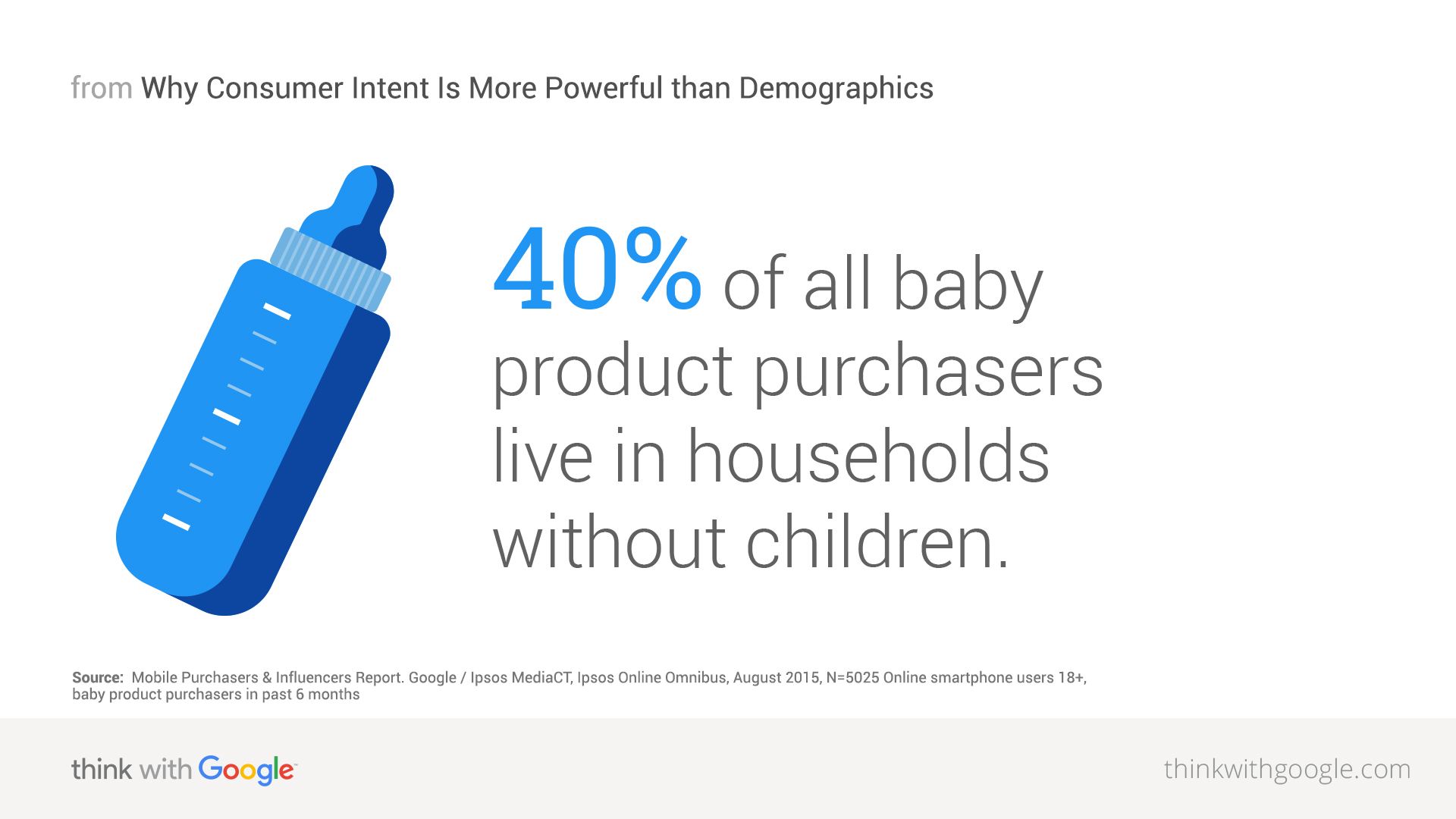
A study published by Think with Google in December 2015 found that 40% of baby product buyers and 52% of baby product influencers live in households without children.
This is not the target audience—or a secret society of cat ladies who dress up like Miss Havisham. These people are often the child's grandparents or sometimes the parents' friends, cousins and classmates.
Then show students how to use Google Trends to search for consumer interest in specific search terms, such as "baby products."
After that I ask you to scroll down to see the related searches
Finally, I would like to ask if you think people looking for "best baby products" are a different target group than those looking for "free baby products".
Or when creating content that attracts customers interested in "baby hair products" that also attracts customers interested in "baby skin products".
In January 2021, I learned from CMI research that 63% of B2C marketers have changed messaging/targeting strategies in response to the pandemic, but only 18% are rethinking customer/buyer personas.
This means that many of them are probably putting the cart before the horse.
So I showed students how to use Find My Audience on YouTube to identify demographics, markets (ie people who are actively looking for or plan to buy products or services across 20 categories) and affinity segments (ie what the company offers in 12 categories. ) that are relevant to their business. most relevant to
If 57% of B2C marketers now say that creating content that appeals to a different audience, showing different ways to segment their audience and creating a consumer persona may be a better solution than them saying that more strategic content helps them in the process. . Widely to meet the needs of different audiences.
Why? As Rose himself says:
"Often the first sign of a problem with any content marketing approach is when you hear, 'How can we be more effective with content?'"
In other words, focus on doing the right thing (effectiveness) before focusing on doing the right thing (efficiency).
Develop consistency with measurement
According to a recent survey by CMI, 44% of B2C marketers say their biggest challenge is developing measurement consistency.
Well, it will still be a challenge – especially since Universal Analytics (UA) from Google will stop processing data on July 1, 2023.
Unless their business migrates to Google Analytics 4 (GA4), B2C marketers will need another 12 months to compare their results for that month to the same month last year.
Why?
Because UA introduced by Google in October 2012 uses session-based data while GA4 uses event-based data. UA uses easily observable data from cookies, while GA4 uses cookie-free measurements, transformations and behavioral modeling.
So comparing data and statistics with events and conversions from UA to GA4 is like comparing small green apples to oranges in sumo.
But it can be a blessing in disguise.
According to a recent survey by CMI, 70% of B2C marketers say that content marketing has become more important to their business in the past year.
But many of these marketers say they're still struggling to get more staff, more budget and better access to subject matter experts.
So it appears that the key performance indicators (KPIs) that most B2C marketers rely on when evaluating content effectiveness are inconsistent with the business and marketing goals their organizations are trying to achieve.
This means that B2C marketers need to address the challenges they face in measuring content performance this year so they can focus on achieving alignment with next year's metrics.
Fortunately, they don't have to wait until their UA migration to GA4 is complete before adjusting their metrics and adjusting their KPIs for the top four goals that content marketing is trying to achieve:
- Build brand awareness.
- Build credibility/trust.
- Public education.
- Build/expand loyalty with existing client/clients.
How do B2C marketers measure KPIs today?
Well, I hope they don't use "vanity metrics" like impressions, video views, page views, and bounce rates.
So how should B2C marketers measure their performance against the top four goals?
Well, if your goal is to build brand awareness, use brand surveys before and after your content marketing campaign.
Pre-campaign surveys provide a baseline for your brand awareness, and post-campaign surveys accurately measure the impact of your content marketing.
If your goal is to build credibility/trust, periodically ask whether people agree or disagree with a set of statements.
For example, on a scale of 1 (strongly agree) to 7 (strongly agree), how much do you agree/disagree with the following statements:
- "You can count on this company to deliver on its promises."
- “I have great confidence in the ability of this organization.
- "This organization has the ability to deliver on its promises."
- "Great principles seem to guide the behavior of this organization."
- "This company doesn't fool people like me."
- "This company has a reputation for being successful in what it tries to do."
If your goal is to educate your audience, use online tests and quizzes - just like teachers.
And if your goal is to build or increase the loyalty of existing clients or customers, conduct customer loyalty surveys.
For example, a Net Promoter Score (NPS) asks a customer, "How likely are you to recommend this company to a friend or colleague?"
It should be noted that none of these KPIs are included in the list of metrics that most B2C marketers rely on when evaluating content effectiveness.
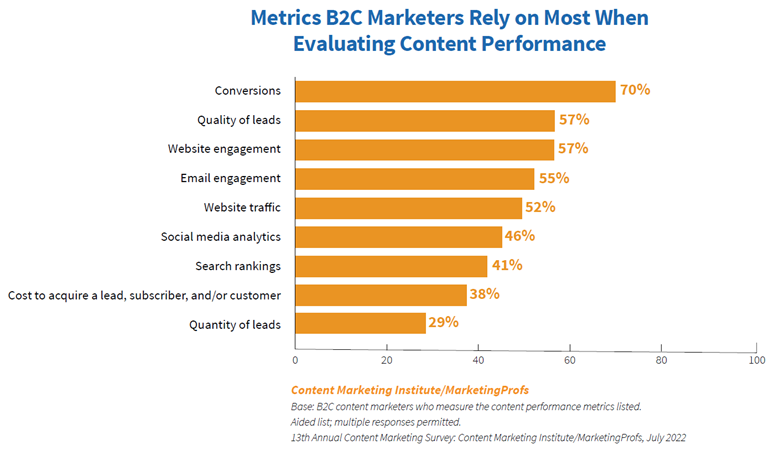
Not surprisingly, only 11% of B2C marketers said, "We have no problem measuring content performance."
On the other hand, if your goals include the following, you should move to GA4 as soon as possible:
- Search or generate leads.
- Maintain customers, visitors or prospects.
- Create or grow a collective audience.
- Manage attendance at one or more in-person or virtual events.
- Generate sales or revenue.
- Support new product launches.
Next, insist on getting an editor role so you can set up events, convert tags, compare attribution models, analyze lifecycle reports, gain deep insights, work on analytical intelligence, build audiences and enable remarketing
To learn more, see Getting started with Google Analytics 4 features on YouTube.
And make sure the metrics and KPIs you rely on most this year align with the business and marketing goals your company is trying to achieve.
This will help you win next year's battle for more staff, more budget and better access to subject matter experts
Differentiate your product/service from the competition
It seems strange that 40% of B2C marketers say that differentiating their product/service from the competition is their biggest challenge.
This is usually the responsibility of brand or product managers, who may have to cut their budgets for market research, competitive analysis tools, and innovation consulting because their wiser bosses tell them to "do more with less."
Therefore, B2C marketers have two options: they can update their resumes and join the Great Resignation, or they can invite their company's weak brand and product managers to a brownie brunch.
Now many Americans are leaving their jobs in 2021 and 2022 because their pay is too low, there is no opportunity for advancement, and they do not feel respected at work.
With the global economy expected to slow this year, the first option seems risky.
Therefore, I strongly recommend you to consider the second option. What would you discuss in an informal meeting with your brand and product managers?
Well, sharing strategic insights, key data and industry trends will be mutually beneficial.
Heck, your brand and product managers will probably be just as interested as you:
- Explore different ways to segment your audience and create consumer personas.
- Align your metrics and KPIs with the goals and objectives of the CEO, CMO and CFO.
- Introducing a new product or service that gives your business a competitive edge.
You can even convince your brand or product manager to be a subject matter expert for your next campaign.
And communicating internally across teams or silos can help you build a better content marketing business case.
যাইহোক, এই মধ্যাহ্নভোজ এবং অধ্যয়ন অধিবেশনের প্রাথমিক লক্ষ্য হল বিষয়বস্তু বিপণন "একটি কৌশলগত বিপণন পদ্ধতি যা নির্দিষ্ট শ্রোতাদের আকৃষ্ট করতে এবং গ্রাহকের ক্রিয়াকলাপকে জড়িত করার জন্য মূল্যবান, প্রাসঙ্গিক এবং সামঞ্জস্যপূর্ণ সামগ্রী তৈরি এবং বিতরণের উপর ফোকাস করে এবং শেষ পর্যন্ত এগিয়ে যাওয়ার জন্য। "
আমি এটা দরকারী হবে আশা করি.
যদিও আপনি B2C বিষয়বস্তু বিপণন সম্পর্কে যা শিখেছেন তার কিছু দিতে হতে পারে, এটি আপনাকে এই বছর যে অর্থনৈতিক চ্যালেঞ্জগুলির মুখোমুখি হতে হবে তা মোকাবেলা করতে সহায়তা করবে।
আরও সম্পদ:
বৈশিষ্ট্যযুক্ত চিত্র: eamesBot/Shutterstock


Comments
Post a Comment