What Is A Digital Marketing Strategy? 5 Steps To Create One

Every successful business needs a successful digital marketing strategy.
Developing a strategy is one thing, but executing it is just as important, if not more so.
But where is the best place to develop and optimize your strategy as the digital landscape changes every day?
Read on to learn how to create a successful digital marketing strategy for your brand.
What is a digital marketing strategy?
Digitization must inevitably become the backbone of your overall marketing strategy.
Since it takes an average of 12 touchpoints and two months for a customer to go from insight to sale, many of those touchpoints will be digital.
Although there is no clear definition of what a digital marketing strategy is, it can be summarized as follows:
A digital marketing strategy is part of a broader business plan that describes how to achieve overall business goals through digital channels.
A digital marketing strategy should be tailored to the company's key performance indicators (KPIs). Key elements of developing a successful strategy include:
- digital channels.
- target group and regions.
- Basic message elements.
- budget.
A digital marketing strategy identifies specific channels for targeting and converting a company's ideal customers.
These channels may include (but are not limited to):
- search engines
- social media platforms.
- Sites:
- applications:
Channel identification is only part of a digital marketing strategy. The second key point is to send consistent and relevant messages to your target audience.
While the overall message must be consistent across all channels, the way brands engage and engage with customers will and should vary by platform.
Digital strategy vs. tactics
Many brands tend to confuse strategies and tactics and end up confusing them.
While both are important elements of a marketing plan, strategy and tactics have different definitions and serve different purposes.
As mentioned above, strategy is part of a broader business plan that helps brands achieve overall company goals.
Rather, tactics are planned actions to implement a broader marketing strategy.
Key differences between digital strategies and tactics
| strategy | tactics |
|---|---|
| Focused on long-term goals | Focus on short-term goals |
| Part of a larger business plan | There can be measurable goals |
| the direction of the wave | field oriented |
| focused on the target group | action oriented |
| Provides a tactical road map. |
An example of a digital strategy would be paid media marketing. Tactics that fit into paid media marketing can include:
- Run paid search ads on Google or Microsoft.
- Google Display Network (GDN) audience tests.
- Check your landing page or ad text to optimize your conversion rate.
In summary, tactics are not the same as strategy. Strategies are created to then inform what tactics to use.
Examples of digital strategies
While digital marketing strategies may have similar characteristics across brands, each strategy and its tactics are different. Strategies are not the same for everyone.
Below are some of the most common digital marketing strategies used by brands around the world:
- Pay-per-click (PPC) advertising.
- Search engine optimization (SEO).
- content marketing.
- Electronic trade.
- spam.
- Marketing in social networks.
ppc advertising
PPC marketing is a form of online advertising where brands pay each time a user clicks on their ad and is redirected to the company's website. Typically, PPC campaigns are run through Google and Microsoft Ads.
Both PPC platforms have multiple campaign types to choose from depending on the advertiser's goals. This may include:
- search ads.
- display ads
- purchase announcement
- Advertising on YouTube.
- notice of application.
- View the ads.
- maximum power
- And more.
PPC advertising can be targeted to specific audiences or masses depending on the brand's goals. PPC is commonly used for brand traffic, sales and conversion.
Below is an example of a PPC ad on Google Search.
SEO:
An SEO strategy involves optimizing a brand's website, app, or content so that it can rank higher on search engine results pages (SERPs).
Optimizing your website and brand content helps improve visibility in organic (free) search and ultimately drives more traffic to your site.
SEO is considered a long-term strategy, and while there are usually no "hard" costs (as with PPC advertising), it does include indirect costs such as:
- Time and Compensation of Employee or Agency.
- Cost of third-party technology or platform.
One of the benefits of a strong SEO strategy is that reliance on PPC marketing can be reduced over time, making the budget more efficient.
Using the same search query example [ppc software], below is an example of organic listings and answer boxes on Google SERP.
content marketing
This strategy is more "behind the scenes", so to speak. It's about creating (and sharing) unique and valuable content with a company's target audience.
Part of a content marketing strategy is to create different types of content for each digital platform.
For example, if a brand wants to create content for the TikTok platform, the content will be in the form of short videos (up to three minutes).
Conversely, a brand looking to build brand awareness may need to create a detailed article and blogging strategy to distribute on their website.
The goal of content marketing is to build and establish trust with your target audience and turn them into long-term customers.
Using the same example from the PPC section above, below is an example of content marketing. The Skai (formerly Kenshoo) brand posts blog posts for its readers to increase engagement.
electronic commerce
If a brand sells physical products, an e-commerce strategy should be central to the company's business goals.
Activating an e-commerce strategy means creating an online store where consumers can buy products.
Some tactics of an e-commerce strategy may include:
- Creating an online store where brands sell directly to consumers (DTC).
- Sell physical products on online marketplaces like Amazon.
- Creating affiliate sales programs where others are paid to promote the brand's products.
- Paid trade ads on Google and Microsoft to increase sales.
- Marketing influencers and brand ambassadors.
spam
This part of the digital strategy involves sending targeted emails to prospects and customers. The ultimate goal of email marketing is to generate leads, sales, or business and keep repeat buyers on the customer journey.
For example, a bride-to-be is looking for the perfect wedding invitations after getting engaged.
Once a user signs up for a branded email or marketing communication, an email is created. May include:
- Promotion of free wedding invitation templates.
- Discounts on wedding invitations.
- Free (or discounted) post-wedding thank you cards.
- A referral program to generate word of mouth sales.
Email marketing is a great way to talk to your target audience and build lasting relationships with customers even after the first purchase.
Below is an example of a targeted ad email sent to my inbox:

social media marketing
Depending on the brand, a social media marketing strategy has different uses and goals.
As part of a broader digital marketing strategy, social platforms must be chosen to promote content or engage in a specific way with a target audience.
Below are just a few tactics that can be used in social media marketing:
- Creating organic content for publishing.
- Place paid ads on targeted platforms.
- Launch effective marketing campaigns based on your target.
Using the same branding example from the email section, below is an example of a retargeting (meta) Facebook ad:
How to create a digital strategy in 5 steps
As mentioned above, a digital marketing strategy should be created after defining the overall business goals.
For this reason, the stages of creating a successful digital strategy include specific steps that help achieve larger business goals.
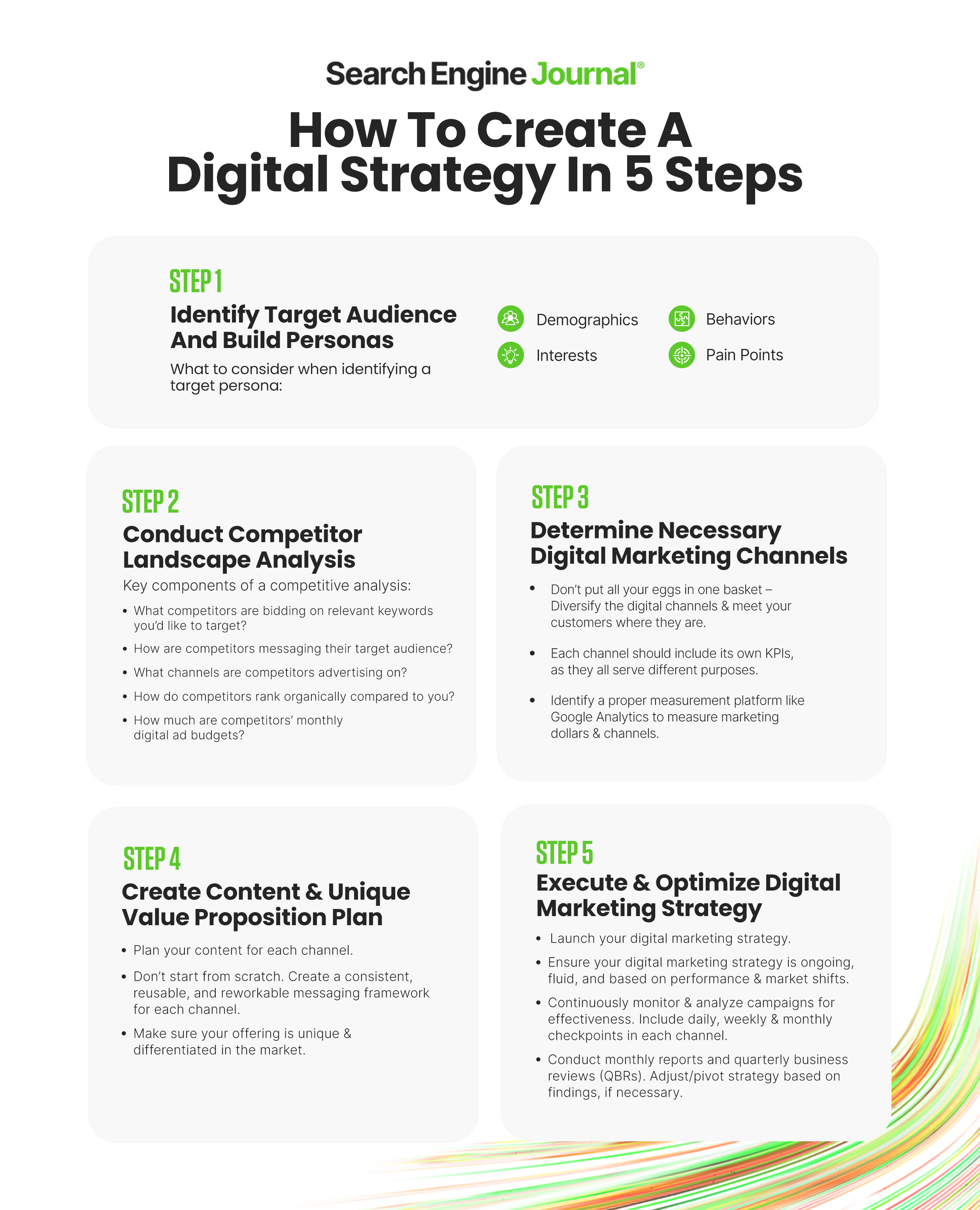
Step 1: Define your target audience and create personas
A digital marketing strategy is only as good as the target audience behind it. After all, they are the ones who buy your brand's products and services.
When setting a goal, keep the following points in mind:
- Demographics After deciding where to market your products/services, determine if key regions can outperform others. Other demographic categories include age, parental status, family income, and more.
- interests What preferences do you give to your ideal person? This information can help develop content for the client.
- behavior How (and where) do these users consume content online? Are they impulse buyers? What social platforms do they visit?
- Pain points . What problems are users trying to solve? This is a major area to focus on. By giving your target audience a solution to their problems and addressing them in a way they understand, you are likely to win a customer for life.
Step 2: Conduct a competitive landscape analysis
It is important to understand the digital landscape before diving into the digital waves.
The main components of conducting a competitive analysis include:
- Which competitors offer relevant keywords that you want to target?
- How are competitors talking to their target audience?
- On what channels do competitors advertise?
- How do competitors organically relate to you?
- What is your competition's monthly digital advertising budget?
Third-party tools like SEMrush, SpyFu, Google Keyword Planner, and Google Trends can help answer many of these questions.
Please note that information provided by third-party tools is not 100% accurate and should be used as a guide and not as absolute accuracy.
Step 3: Identify the digital marketing channels you need
Once you know who your target audience is and where they go online, it's time to decide what your primary digital marketing channels are.
Ideally, a combination of channels is chosen, as it is not desirable to choose one or two and put everything on one card.
The key is to diversify your digital channels and meet your customers whenever and wherever they are online.
These channels likely include all of the channels listed above in the Digital Strategy Examples section.
Each featured channel should contain its own set of KPIs. They are defined by marketers and the largest business teams.
Make sure you don't set the same KPIs and metrics for each channel as they all serve different purposes.
Creating realistic measurement goals ensures that awareness channels are measured based on awareness KPIs, such as brand awareness, rather than direct conversions.
As with any digital channel, it's important to understand how to measure it.
This step should include identifying a suitable measurement platform, such as Google Analytics or another tool, to ensure that marketing and spend channels can be measured.
Step 4: Create content and a unique value proposition
Once you've identified your digital channels, it's time to plan content for each channel.
The key is to create a consistent messaging structure that can be reused and recycled across all channels. So don't start from scratch every time.
For example, if you want to represent your brand on YouTube or the Google Display Network, your content should not be aimed at direct conversion or call to action "buy now". That's too much to ask for at the start of brand awareness.
On the other hand, for those who have come a long way and are looking for certain products and services, now may be the time to introduce discounts and special offers.
Finally, make sure that what you offer your customers is unique and differentiated in the market. First, conducting a competitive analysis will help you find out what is currently being offered in the market.
Even if your product or service is similar to competitors' products, it's important to find a way to differentiate your brand.
Step 5: Implement and optimize your digital marketing strategy
Once you've determined steps 1-4, it's time to start your digital marketing strategy.
However, the work is not finished yet. Your digital marketing strategy should be continuous and flexible, based on performance and the changing market landscape.
Digital marketing channels and campaigns need to be constantly monitored and analyzed to ensure that marketing budgets and resources are being used optimally.
This should include daily, weekly and monthly checkpoints on each channel.
Monthly reports and quarterly business reviews (QBRs) should be conducted to allow for change and align strategy based on results.
Summary:
Digital marketing strategies are not a one-size-fits-all solution. Nor should they be your only branding strategy.
While it's important to think "digital first" when it comes to strategy, it must be aligned with core business goals.
Don't confuse strategy and tactics and end up falling into a "tactics first" approach.
By taking the time to develop a strong digital marketing strategy, you set your brand up for long-term success and the ability to drive change based on performance.
Additional resources:
Featured image: ImageFlow/Shutterstock


Comments
Post a Comment